
20261025 | Chinese Chan Talk Series
Would Life Be Dull If We Stopped Chasing?
No-Thought, No-Form and Non-Abiding in the Platform Sutra
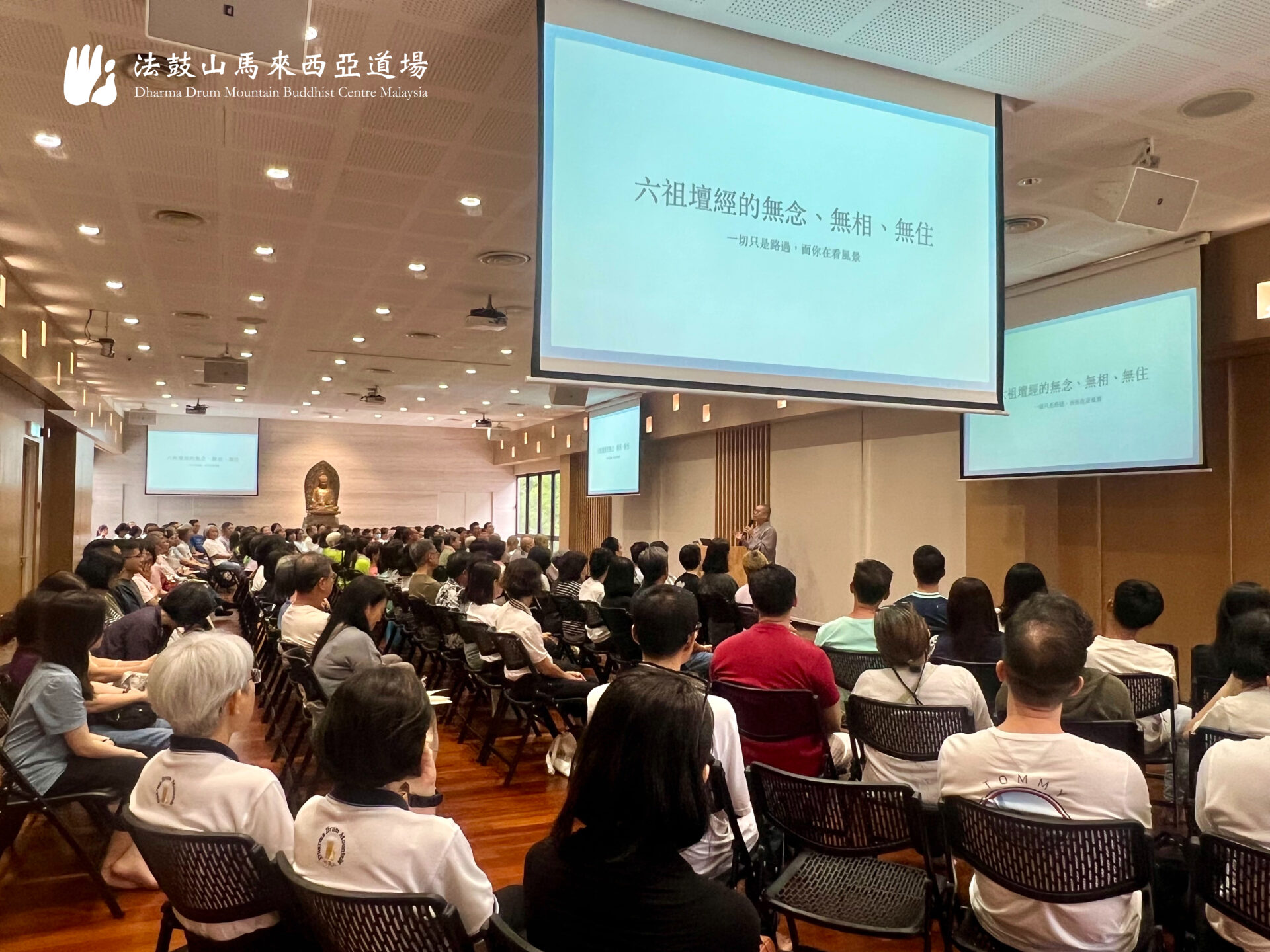
When we see a beautiful view, we often reach for our phones to capture the moment. But when appreciation comes with the wish to hold on to an experience or make it ours, what is happening in the mind? On 25 October, more than 200 people attended a talk on Chinese Chan at Dharma Drum Mountain Buddhist Centre Malaysia on the topic of no-thought, no-form and non-abiding in the Platform Sutra. The speaker was Venerable Yan Jian, Deputy Chief Monastic of DDM Sangha Malaysia.
Taking as his starting point the phrase “Everything is passing by as you take in the view,” Venerable Yan Jian shared a question raised during a seven-day Chan retreat that had just ended. During outdoor walking meditation, participants were asked to keep their gaze lowered and pay attention to the movement of their feet. If they were not supposed to look around, what was the point of going outside? This question ran through the talk’s exploration of practice and everyday life.
What the Scenery Reveals About the Mind
The Platform Sutra of the Sixth Patriarch takes no-thought as its aim, no-form as the means of practice, and non-abiding as its foundation. Drawing on the teachings of Dharma Drum Mountain founder Master Sheng Yen, Venerable Yan Jian explained that the sutra uses prajna (or wisdom), to free us from afflictions and attachment, pointing towards “illuminating the mind and seeing one’s nature.” Illuminating the mind means revealing the pure mind free of afflictions; seeing one’s nature refers to directly realising the Buddha-nature that is no different in sentient beings and Buddhas. These are two aspects of realisation.
Understanding no-thought, no-form and non-abiding begins with dependent origination and emptiness: everything exists through causes and conditions, without an independent, unchanging nature of its own. To explain no-form, Venerable Yan Jian used the example of flowers offered to the Buddha. Their forms are visible, yet constantly changing. Recognising their emptiness does not deny their existence.
For non-abiding, he pointed to our wish for blue skies and white clouds every day. Circumstances keep changing, while the mind wants pleasant conditions to last. When that expectation is disappointed, afflictions readily arise. Practising non-abiding means recognising that circumstances and thoughts are continually changing, and loosening the demand that they always conform to our wishes.
Letting Thoughts Arise Without Being Carried Away
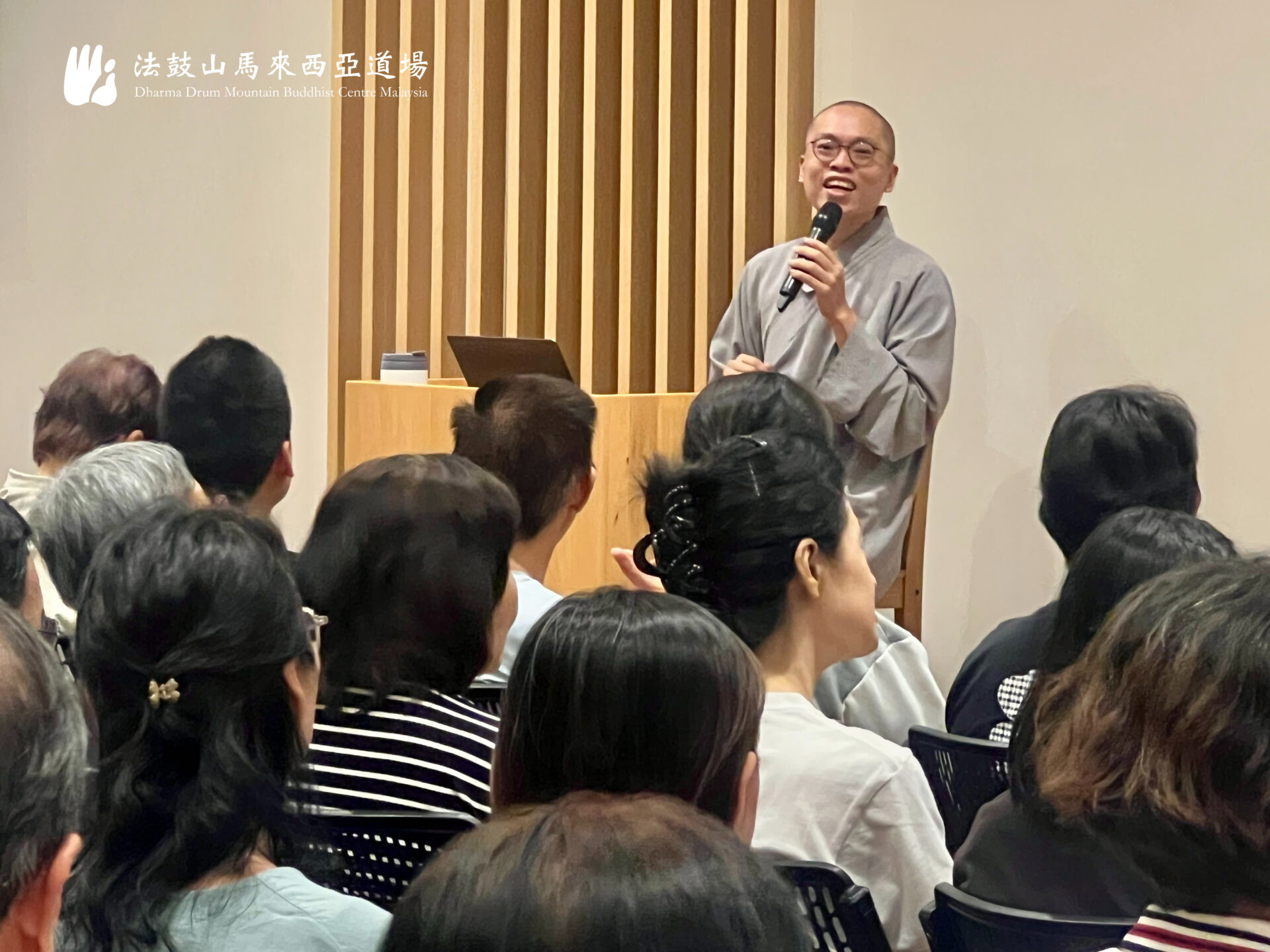
Venerable Yan Jian clarified that no-thought does not mean stopping all thoughts. It means that the mind is no longer entangled in self-grasping, afflictions and selfishness. Beginners still need a concrete focus for practice. During walking meditation, for example, we practise by being fully aware of the movement of the feet. Gradually, we recognise that thoughts, too, arise and pass away, and learn not to identify with them or cling to them as “me.”
He encouraged the audience to practise awareness of the thought arising in every present moment. If we do not manage it in this moment, we can begin again in the next. When we notice that the mind has drifted away with wandering thoughts, we return to the method. Through this repeated practice, our understanding of concepts gradually becomes our own experience
Letting Go of Attachment While Continuing to Care
When we find ourselves still caught in afflictions, Venerable Yan Jian suggested beginning with repentance. Feeling superior to others gives rise to pride; seeing others do better can stir jealousy. Both revolve around concerns of “me.” Beginners can start with honest reflection, correcting their behaviour and resolving not to follow these afflictions. From there, they work towards formless repentance and freedom from self-grasping.
He also discussed the Chan encounter dialogues about the wind and the flag. Two monks looked at the same fluttering flag, each insisting on his own interpretation. One insisted that the wind is moving and the other the flag. The Sixth Patriarch of the Chan school, Master Huineng brought their attention back to their minds. A flag naturally moves when the wind blows. What calls for awareness is how our positions and preconceptions lead us to add judgements to what we see, giving rise to afflictions and arguments.
When family members speak to us, we need to respond; when volunteering, we need to attend to others’ needs. Through these examples, Venerable Yan Jian emphasised that practice transforms our attachments while leaving our ability to see, hear, perceive and understand clear and responsive. Wisdom and compassion can then find expression in our dealings with others. At the close, he returned to the question that opened the talk: how would an awakened person relate to the scenery before them? It was a question for everyone to continue exploring in meditation and daily life.
Text by Lo Chee Hoe
Photos by Lim Chin Tong
20261004 Chinese Chan Talk Series report