
20251220-21 WACANA 2025 Buddhist Conference
𝗕𝗲𝘆𝗼𝗻𝗱 𝗩𝗼𝗹𝘂𝗻𝘁𝗲𝗲𝗿𝗶𝘀𝗺: 𝗦𝗲𝗿𝘃𝗶𝗰𝗲 𝗮𝘀 𝗮 𝗣𝗮𝘁𝗵 𝗼𝗳 𝗔𝘄𝗮𝗸𝗲𝗻𝗶𝗻𝗴
𝘛𝘦𝘹𝘵 𝘣𝘺 𝘓𝘰 𝘊𝘩𝘦𝘦 𝘏𝘰𝘦
𝘗𝘩𝘰𝘵𝘰𝘴 𝘣𝘺 𝘓𝘦𝘰𝘯 𝘊𝘩𝘢𝘯, 𝘓𝘪𝘮 𝘊𝘩𝘪𝘯 𝘛𝘰𝘯𝘨, 𝘚𝘢𝘸 𝘉𝘦𝘯𝘨 𝘏𝘰𝘯𝘨
Dharma Drum Mountain (DDM) was honoured to be invited as a forum speaker and Field Engagement host at WACANA 2025 Buddhist Conference, jointly organised by Nalanda Institute Malaysia and the Theravada Buddhist Council of Malaysia.
Held on 20 December 2025 at Menara KEN TTDI, the conference gathered monastics, Buddhist leaders, volunteers, and practitioners across traditions to explore the theme “Awakening to Community Well-being: Contemporary Approaches.” On 21 December, DDM was one of three organisations invited to host a Field Engagement Session, sharing its approach to volunteer training and development.
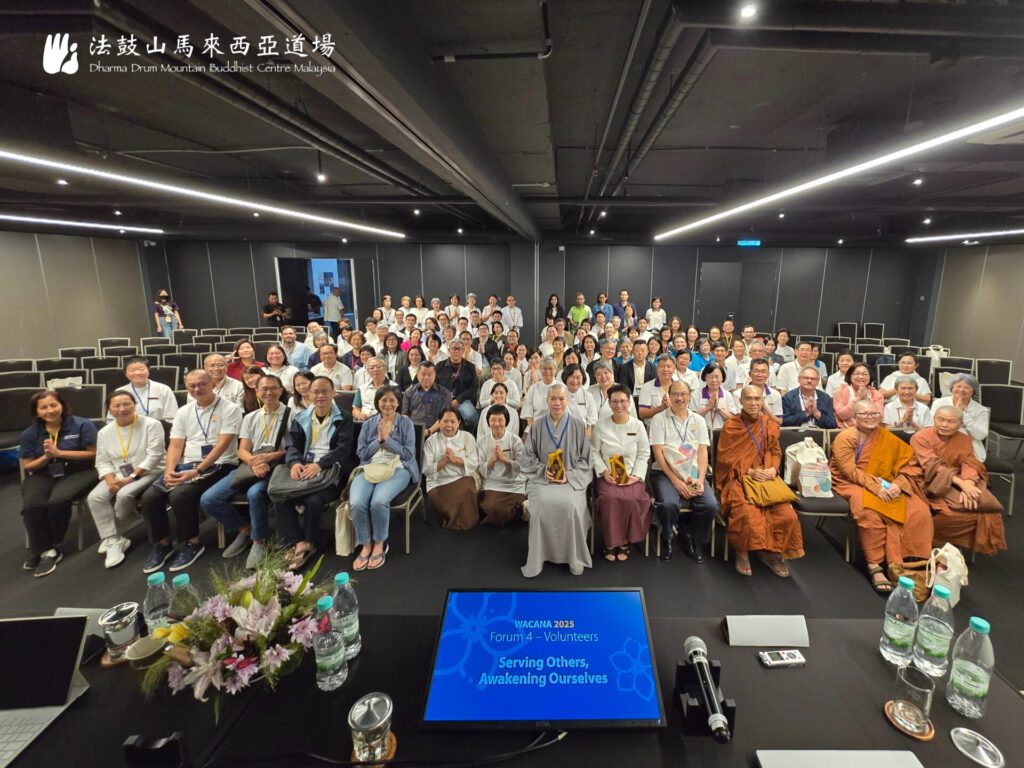
𝗙𝗼𝗿𝘂𝗺 𝗼𝗻 𝗩𝗼𝗹𝘂𝗻𝘁𝗲𝗲𝗿𝘀 – 𝗦𝗲𝗿𝘃𝗶𝗻𝗴 𝗢𝘁𝗵𝗲𝗿𝘀, 𝗔𝘄𝗮𝗸𝗲𝗻𝗶𝗻𝗴 𝗢𝘂𝗿𝘀𝗲𝗹𝘃𝗲𝘀
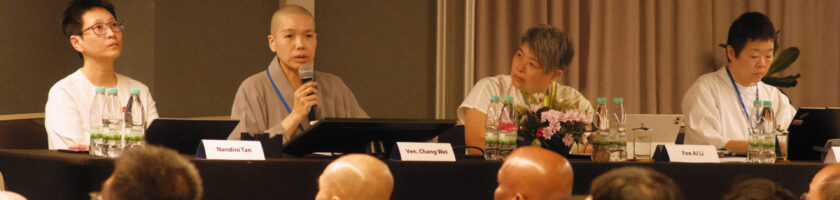
One of the key elective sessions on the first day was the Forum on Volunteers, chaired by Foo Ai Li and featuring two speakers: Venerable Chang Wei, Executive Officer of Dharma Affairs at Dharma Drum Mountain, and Nandinī Tan, Director of Nalanda Centre.
The forum explored volunteerism, sustainable Buddhist communities, and service, with a focus on aligning volunteerism with Buddhist practice, understanding the motivations and core values that sustain volunteers, and identifying the systems needed to support long-term, meaningful service.
𝘚𝘦𝘳𝘷𝘪𝘤𝘦 𝘎𝘳𝘰𝘶𝘯𝘥𝘦𝘥 𝘪𝘯 𝘗𝘳𝘢𝘤𝘵𝘪𝘤𝘦
Venerable Chang Wei introduced The Common Endeavour of Buddhists, a set of 20 verses recited at the beginning of every DDM meeting and activity. The verses culminate in the aspiration to uplift the character of humanity and build a pure land on earth, reminding practitioners to uphold faith in the Three Jewels, practise gratitude and the repayment of kindness, exert wholehearted effort without calculation, cultivate kindness free from enmity, and develop wisdom without vexation.
She clarified that these verses are not merely recitations, but practical guidance for daily life and service, offering a shared ethical compass for personal cultivation and collective action. Quoting Master Sheng Yen, the founder of DDM, Venerable Chang Wei cited a teaching that resonated strongly with volunteers: “When we do not have physical strength, we rely on mental strength; when mental strength is insufficient, we rely on our vows.”
She further elaborated that, according to Master Sheng Yen, the purpose of life is not a single moment of awakening, but a continuous process of fulfilling responsibilities, making and upholding vows, accepting karmic results, and dedicating oneself to benefiting others. Through sustained practice and service, this process unfolds as a gradual movement from knowing, to affirming, developing, and ultimately dissolving the self.
DDM’s guiding spirit: To give of ourselves for the benefit of all, was presented as a practical response to modern social challenges. When individuals focus solely on personal fulfilment, unchecked competition and conflict arise. Conversely, when people contribute to the fulfilment of others, society benefits collectively, and individuals grow in wisdom, compassion, and blessings.
𝘚𝘩𝘢𝘳𝘦𝘥 𝘗𝘦𝘳𝘴𝘱𝘦𝘤𝘵𝘪𝘷𝘦𝘴 𝘰𝘯 𝘚𝘶𝘴𝘵𝘢𝘪𝘯𝘢𝘣𝘭𝘦 𝘝𝘰𝘭𝘶𝘯𝘵𝘦𝘦𝘳𝘪𝘴𝘮
Reflecting on Nalanda’s experience, Nandinī Tan spoke about nurturing sustainable Buddhist communities. Both speakers acknowledged strong common ground in their approaches: service is inseparable from cultivation. Volunteering is not an additional duty, but part of the path of practice, benefiting sentient beings while refining one’s own character through gratitude, humility, and compassion.
Challenges encountered during service were framed as opportunities to observe, contemplate, and transform unwholesome mental states. The forum also underscored that the rewards of service are not measured by recognition or material gain, but by inner growth, joy derived from benefiting others, and a deeper sense of purpose in life. When facing difficulties, returning to the Dharma and maintaining clarity of motivation helps volunteers avoid unnecessary conflict or “drama” and remain grounded in Dharma practice.
The forum concluded with a shared understanding of the motivations behind volunteerism and the conditions needed to sustain it as a form of practice and service.
𝗙𝗶𝗲𝗹𝗱 𝗘𝗻𝗴𝗮𝗴𝗲𝗺𝗲𝗻𝘁 𝗦𝗲𝘀𝘀𝗶𝗼𝗻 – 𝗧𝗿𝗮𝗻𝘀𝗹𝗮𝘁𝗶𝗻𝗴 𝗣𝗿𝗶𝗻𝗰𝗶𝗽𝗹𝗲𝘀 𝗶𝗻𝘁𝗼 𝗣𝗿𝗮𝗰𝘁𝗶𝗰𝗲
On the second day, DDM hosted a Field Engagement Session, welcoming participants to experience how these principles are applied in practice. The session opened with a welcome by Venerable Chang Zao, Chief Monastic of Dharma Drum Mountain Sangha Malaysia. She recounted that DDM Malaysia was established in 1999, initiated by a lay practitioner who, after attending a seven-day Chan retreat conducted by Master Sheng Yen, made a vow to make Chan meditation accessible to Malaysians.
Venerable Chang Zao affirmed that Dharma Drum Mountain is not a geographical location or a specific building, but refers to any place where the Dharma is practised and embodied. She then led participants in a guided Chan meditation, reminding everyone that while Buddhist traditions may differ in form, their ultimate goal is the same: the attainment of Buddhahood. Central to this is the principle of “wherever the body is, there the mind is,” encouraging practitioners to live fully in the present moment and apply the same methods consistently throughout daily life.
𝘍𝘳𝘰𝘮 𝘚𝘵𝘳𝘶𝘤𝘵𝘶𝘳𝘦 𝘵𝘰 𝘊𝘶𝘭𝘵𝘪𝘷𝘢𝘵𝘪𝘰𝘯
Participants were guided around the centre and introduced to its statues, emblem, calligraphy, and functional spaces. This was followed by a presentation on DDM’s Volunteer Training Programme by Venerable Yan Jian, Deputy Chief Monastic of DDM Sangha Malaysia.
Venerable Yan Jian outlined a structured pathway for volunteers, beginning with a half-day New Volunteer Training or a 10-month Merit Field Programme, followed by 20 hours of practical service across different volunteer groups, and progressing to intermediate and advanced training. He stressed that DDM does not view volunteering as merely “getting the job done,” but as an opportunity to apply the Buddha Dharma in real-life situations and to walk the Bodhisattva path through service.
𝘍𝘳𝘰𝘮 𝘐𝘯𝘯𝘦𝘳 𝘊𝘶𝘭𝘵𝘪𝘷𝘢𝘵𝘪𝘰𝘯 𝘵𝘰 𝘚𝘰𝘤𝘪𝘢𝘭 𝘌𝘯𝘨𝘢𝘨𝘦𝘮𝘦𝘯𝘵
During the Q&A session, Venerable Chang Ji highlighted Master Sheng Yen’s teaching on the Four Kinds of Environmentalism, namely spiritual, natural, living, and social environmentalism, emphasising that purifying the mind is the foundation for uplifting human character and fostering harmony in society. She also described DDM’s Threefold Education, which integrates academic education that nurtures talent for research, teaching, and social service; public Buddhist education that popularises the Dharma through Chan meditation classes, retreats, Dharma assemblies, media, and publications; and social care education that extends compassionate care from prenatal education to end-of-life support, including social relief and Buddhist funeral services.
During interactions and exchanges with participants, Venerable Chang Zao offered a reflection that when encountering the promotion of non-orthodox Buddhist teachings, responding through direct criticism or opposition can easily give rise to division and confrontation. Instead, she suggested that greater emphasis be placed on strengthening the propagation of right understanding and right practice, allowing authentic Buddhism to be recognised through conduct and embodiment rather than conflict.
On engaging youth in volunteerism, Wong Chun Kit, Lead for Volunteer Growth and Planning Division, noted that attracting and retaining young volunteers is not inherently difficult, but requires creativity, openness, and a willingness to think beyond conventional approaches. He observed that relatable activities such as festive gatherings, or Tea Chan and Coffee Chan, where Chan meditation is practised through tea or coffee brewing, help youth connect with Buddhism naturally while fostering intergenerational interaction and deeper mutual understanding through volunteering.
For Beh Kee Chew, volunteering at DDM has been a deeply rewarding experience, with the soft skills developed and a sense of inner stability and calm naturally extending to family members and colleagues, and proving particularly useful in the workplace when navigating challenges and adversity in life.
𝗠𝗼𝘃𝗶𝗻𝗴 𝗙𝗼𝗿𝘄𝗮𝗿𝗱
DDM’s participation in WACANA 2025 provided a meaningful platform for sharing, exchange, and mutual learning alongside fellow Buddhist organisations, exploring how volunteerism can be nurtured as a path of practice rather than merely a functional necessity. The discussions reinforced the importance of clear motivation, shared values, and supportive systems in sustaining volunteers and cultivating healthy Buddhist communities.
As the conference drew to a close, participants were invited to reflect on how these insights might be adapted within their own communities, so that serving others may continue to be a source of joy, growth, and collective well-being, and that the Buddha Dharma may endure and flourish.